Quick take
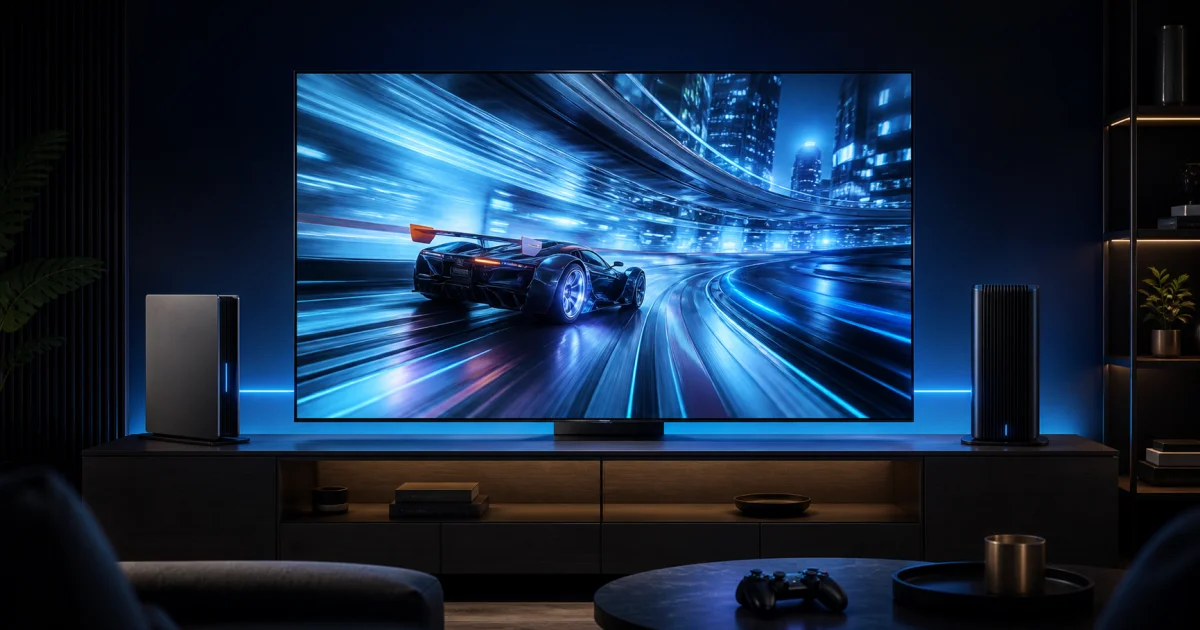
Neither Sony nor Microsoft has confirmed HDMI 2.2 or 4K 240Hz output for its next console. The standard can carry uncompressed 4K at 240Hz, and that could improve latency, motion and frame-rate flexibility even when games run far below 240fps.
The next generation of game consoles could introduce one of the biggest TV gaming upgrades since 4K at 120Hz arrived.
Industry reports point to a possible 2027 launch window, but no release date has been confirmed. Microsoft has confirmed that its next-generation console, Project Helix, is in development with a custom AMD system-on-chip. Microsoft plans to ship alpha hardware to developers beginning in 2027, while its final specifications and consumer launch timing remain unknown.
That leaves one important question: will future consoles support HDMI 2.2 and potentially send a 4K 240Hz signal to compatible TVs?
What is HDMI 2.2?
HDMI 2.2 is the newest major version of the HDMI specification used to connect TVs, game consoles, media players, AV receivers and soundbars.
Its maximum bandwidth rises from HDMI 2.1’s 48Gbps to as much as 96Gbps. The extra capacity allows higher resolutions, faster refresh rates and greater color depth.
| Signal format | How HDMI 2.2 carries it |
|---|---|
| 4K at 240Hz | Uncompressed, full chroma at 10-bit or 12-bit |
| 8K at 60Hz | Uncompressed, full chroma |
| 4K at 480Hz | With compression or chroma subsampling |
| 8K at 240Hz | With compression |
The specification also introduces the Latency Indication Protocol (LIP). It is designed to improve audio and video synchronization in multi-device setups that include equipment such as an AV receiver or soundbar.
Will PS6 and the next Xbox really run games at 4K 240fps?
Support for a 4K 240Hz output signal would not mean that every game runs natively at 4K resolution and 240 frames per second.
Large games require enormous processing power. Future consoles will probably continue to offer several graphics modes, such as:
- Higher resolution with a lower frame rate
- Reduced resolution with smoother performance
- Ray-tracing modes
- Balanced graphics and performance modes
The more realistic benefit of 240Hz output is flexibility. A game could run at a stable 80fps while the TV refreshes at 240Hz. Because 80 divides evenly into 240, each game frame remains on screen for exactly three display refreshes. That can produce consistent frame pacing without requiring the game to reach 240fps.
Why 240Hz could still improve console gaming
Lower input latency
A 240Hz display begins a new refresh every 4.17 milliseconds, compared with about 8.33 milliseconds at 120Hz. The end-to-end improvement depends on the console, game and TV, but the shorter refresh interval can reduce the time between a completed frame and its appearance on screen.
That is most useful in competitive shooters, racing games, fighting games, rhythm games and fast sports titles.
A wider VRR range
Variable Refresh Rate lets a compatible TV adjust its refresh timing to match the game’s current frame rate. A future console with 4K 240Hz support could offer a wider usable VRR range and help games remain smooth as performance changes.
Developers could also experiment with targets such as 48fps or 80fps instead of relying only on 30fps, 40fps, 60fps and 120fps modes.
More options for developers
The arrival of 120Hz TVs helped console developers move beyond the traditional 30fps and 60fps targets. A 40fps mode works well on a 120Hz display because each game frame is shown for three refreshes.
The same relationship exists between 80fps and 240Hz. It could let developers offer noticeably smoother play without targeting an unrealistic native 240fps.
Could current TVs support these features?
Most current gaming TVs are limited to 4K at 120Hz or 144Hz through HDMI 2.1. Some premium TVs and monitors can refresh faster, but increased-bandwidth HDMI 2.2 inputs are not yet common.
HDMI Licensing has said that chip manufacturers were expected to sample higher-bandwidth HDMI 2.2 chips in 2026, with the first products using up to 96Gbps expected in 2027. The exact timing and product categories will depend on manufacturers.
A complete 4K 240Hz setup would require every part of the chain to support the necessary mode:
- The console must provide a compatible high-bandwidth output.
- The TV must have a compatible high-bandwidth input and 240Hz panel.
- The cable must support the required bandwidth.
- The game must offer a suitable performance mode.
The certified cable designation for the full 96Gbps link is Ultra96 HDMI Cable. An HDMI version label alone does not guarantee that a device supports the specification’s maximum bandwidth.
Should you wait for HDMI 2.2 before buying a TV?
For most people, there is no reason to delay buying a good TV solely because HDMI 2.2 is coming. Sony and Microsoft have not announced full next-generation console specifications, and it may take years for 4K 240Hz modes to become common in console gaming.
If you are buying a gaming TV now, prioritize features that already provide clear benefits:
- 4K at 120Hz
- Variable Refresh Rate
- Auto Low Latency Mode
- Low measured input lag
- Strong HDR and motion performance
- Enough HDMI 2.1 ports for your setup
- eARC if you use a soundbar or AV receiver
Always check supported resolutions, refresh rates, bandwidth and gaming features instead of relying only on a version number.
What this means for the future of gaming TVs
PlayStation 5 and Xbox Series X helped make 4K 120Hz, VRR and low-latency modes common on premium gaming TVs. A future console generation could have a similar influence on 4K 240Hz.
Even if most games never run at 240fps, a 240Hz output could improve frame-rate options, motion clarity, VRR flexibility and responsiveness. For now, though, HDMI 2.2 support on the next PlayStation and Xbox remains a possibility—not a confirmed feature.
For Your Smart TV
Turn your iPhone or iPad into a TV remote
TV Remote Control: Xio connects to a supported smart TV on the same Wi-Fi network. Use remote buttons, touchpad navigation, playback and volume controls, cast photos or videos, and save TVs for faster reconnection.
Final thoughts
HDMI 2.2 gives future consoles and TVs enough bandwidth to move beyond today’s 4K 120Hz limit. Its biggest gaming benefit may not be 240fps. Instead, 4K 240Hz could give developers more freedom to build stable 48fps, 80fps, 120fps and other high-refresh performance modes.
The standard is ready. The remaining question is whether Sony, Microsoft and TV manufacturers will adopt its higher-bandwidth features for the next console generation.
Sources and editorial note
This article is an original Softlian explanation inspired by FlatpanelsHD’s August 4, 2026 report. Technical details were checked against the HDMI Licensing Administrator’s HDMI 2.2 overview, and Project Helix details were checked against Microsoft’s official Xbox Wire announcement.
PlayStation and Xbox are trademarks of their respective owners. Softlian is not affiliated with Sony, Microsoft or HDMI Licensing Administrator, Inc.